18 m
Skipper yachts up to eighteen metres, your own or a bareboat charter
Nautly teaches you everything the Skipper B exam asks: short lessons for every topic, question-by-question training, and full mock exams. Study a little each day and walk into the Lučka kapetanija ready.
 Free to try · one-time purchase · works offline
Voditelj brodice kategorije B is Croatia's standard recreational skipper licence.
The app takes the whole official syllabus and turns it into a study path you can actually finish: clear lessons for every topic, practice that tracks what you've mastered, and mock exams that tell you when you're ready. In English, Croatian and German.
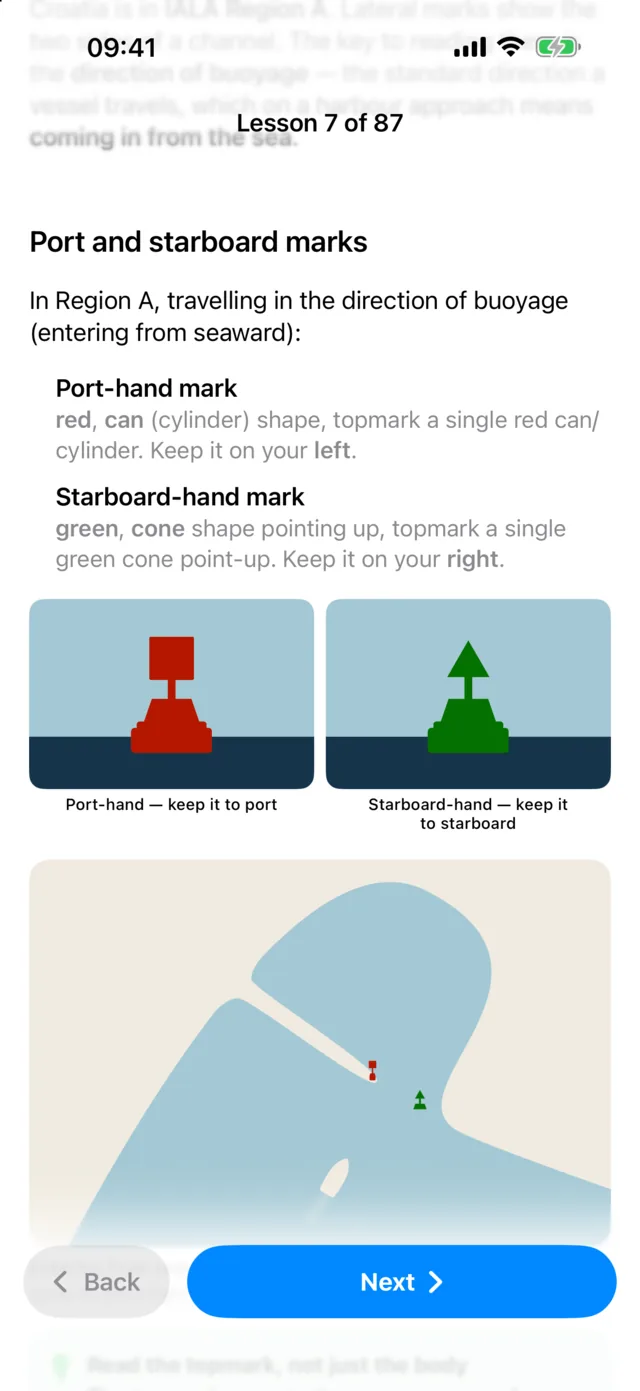
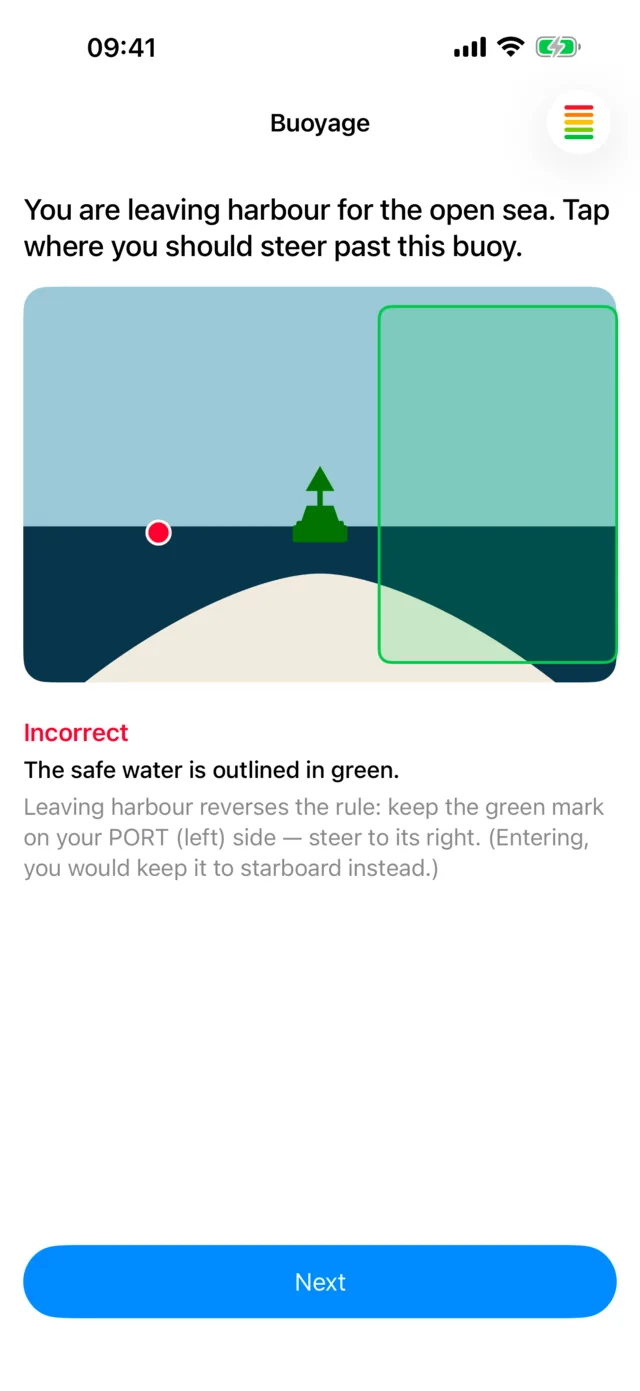
Short, guided lessons walk you through each subject the examiners ask about: right of way at sea, lights and signals, buoyage, chart work, knots and more, one clear step at a time.
Practise question by question, topic by topic, until each one is second nature. The app keeps track of what you've mastered and what still needs another pass.
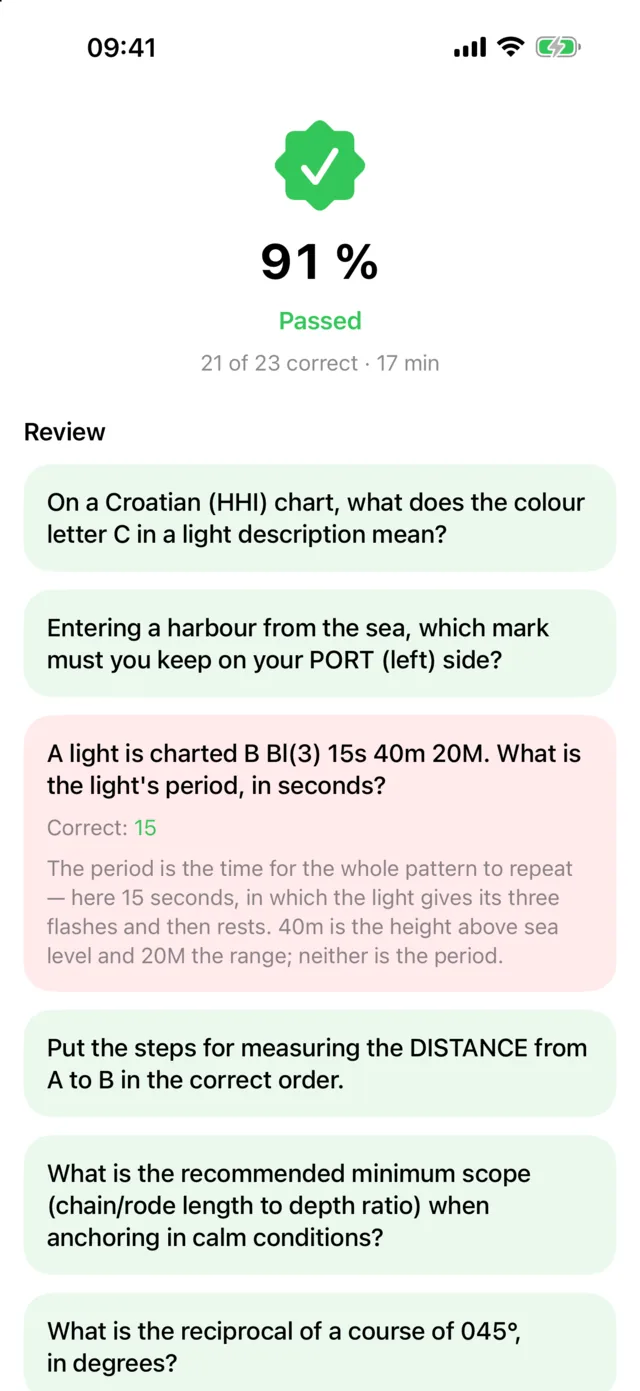
When you're ready, take full mock tests that mirror the real thing, so nothing on exam day at the Lučka kapetanija comes as a surprise.
Prefer to read up first? Everything the exam covers is also on this site as free guides, from the team behind the app.
Voditelj brodice kategorije B is Croatia's standard recreational skipper licence, the one charter companies ask for. The short version:
It lets you skipper a boat or yacht for personal use, including a bareboat charter, in Croatian coastal waters, up to 12 nautical miles from the nearest coast. It's a Croatian national certificate (not an ICC), it never expires, and there's no mandatory course: you study, then sit an oral exam. The finer points live in the free guides.
There's no multiple-choice sheet. You sit an oral exam before a small commission of examiners at the Lučka kapetanija (the harbour master's office) and answer face-to-face. That makes preparation different from most licences: you need to be able to explain things out loud, not just recognise the right answer on a page.
Exams are held at harbour master's offices in major Adriatic ports. You book directly with the local Lučka kapetanija; there is no central online test centre. Most of the time a session lasts around 15–30 minutes, though it can run longer, depending on how quickly you work through chart and navigation questions.
Because there is no written test, passive revision is not enough. The examiners want to hear you explain concepts clearly, not just nod at a correct answer.
Planning to bareboat charter? Operators ask for proof of qualification, and Voditelj brodice kategorije B is the standard Croatian licence they look for. Many also accept recognised equivalents such as the ICC. Policies differ by fleet and vessel, so check with the company before you travel.
If your existing licence isn't accepted, sitting the oral B exam at a coastal Lučka kapetanija is a common path, and there's no mandatory course first. More on renting and chartering in Do you need a boat licence in Croatia?
The basics, answered plainly.
It's the standard Croatian recreational skipper licence. It lets you operate a recreational boat or yacht for personal use in Croatian coastal waters, up to 12 nautical miles from the nearest coast. The minimum age is 16 (under-18s are limited to 15 kW; no power limit from 18), and it's valid for life. Basic marine VHF radio is part of the exam syllabus; the standalone SRC certificate is separate.
As an oral exam at the Lučka kapetanija, before a three-member commission. The examiners ask you questions directly on chart work, the phonetic alphabet, signals and lights, the collision-avoidance rules and basic navigation. You answer in person rather than filling in a test sheet.
Operate a recreational boat or yacht for personal use in Croatian coastal waters, up to 12 NM from the nearest coast. It's a Croatian national certificate, not an ICC, so confirm acceptance before chartering outside Croatia. Basic VHF radio is part of the exam syllabus; the standalone SRC certificate is separate.
The official syllabus and exam are in Croatian, but a lot of the material is international: COLREG, the phonetic alphabet and navigation principles are the same everywhere. That makes it approachable to prepare in English or German first, then learn the Croatian terms.
For bareboat charter you generally need a valid skipper licence. Category B is the standard Croatian qualification; many operators also accept recognised equivalents such as the ICC, though requirements vary by company and boat size.
Some foreign licences work for visiting or short stays, but Croatian charter fleets often want a B licence or an internationally recognised equivalent. If yours is not accepted, you can sit the oral exam at a Lučka kapetanija without attending a formal course first.
At any of the eight harbour master's offices along the coast: Pula, Rijeka, Senj, Zadar, Šibenik, Split, Ploče and Dubrovnik (each Lučka kapetanija also has branch offices), or at the Ministry in Zagreb. Book an appointment directly with the office where you plan to sit the exam.
The Nautly app teaches and drills the whole Skipper B exam: learn every topic, practise question by question, and sit full mock tests. A one-time purchase, works offline, on iPhone.
Thanks, noted.
How much would you pay for an Android version?
Optional
Want to hear if it happens?
At most two emails: one if we decide to build it, one when it is ready. Nothing else ever, and you can ask us to delete your address at any time. Privacy Policy
Noted. Thank you.